




























by Dinesh V K, on May 26, 2026, 9:40:14 PM
Key takeaways from the blog post
- First-generation, rule-based systems struggle to handle complex, unstructured finance processes and rely on human intervention.
- The future of finance operations is shifting from linear workflows to AI-driven orchestration to interpret context and apply guidelines.
- Autonomous operations prioritize decision quality, end-to-end visibility, full auditability, and straight-through processing.
Over the past decade, enterprise finance functions, particularly accounts payable (AP), accounts receivable (AR), and procurement, have undergone a steady wave of digitization. Early gains came from workflow automation, OCR, and rule-based processing, which helped organizations reduce manual effort and improve cycle times. But as many finance leaders are now realizing, traditional automation is hitting a ceiling.

The limits of first-generation automation
Most legacy solutions were built around structured and predictable processes, particularly PO-based invoice flows. These systems perform well when inputs are predictable, rules are static, channels are limited, and exceptions are minimal.
However, modern, real-world finance operations are far more complex:
- Non-PO invoices require contextual invoice interpretation, classification, policy guidelines juxtaposition, and human decision-making through a decision matrix or hierarchy
- Exception handling often involves multiple stakeholders
- Compliance and audit requirements introduce variability
- Data arrives in inconsistent formats across different channels. With channels expanding constantly, this is becoming the norm
As a result, many organizations still rely heavily on manual intervention, even after investing in automation platforms.
Modern finance operations are consequently demanding intelligent solutions that go beyond simply automating tasks to contextually evaluating policy guidelines to make the right decisions.
A new phase: AI-driven orchestration
A new class of platforms is emerging that moves beyond simple, deterministic workflows toward AI-driven decision-making for exception scenarios, based on policy guidelines. These systems are designed not just to execute predefined steps, but to:
- Interpret unstructured inputs
- Apply business context and policy
- Route work dynamically based on the policy guidelines
- Learn from outcomes over time
This shift reflects a broader trend in enterprise technology – the transformation from process automation to decision intelligence to autonomous operations.
It is within this context that platforms like FINATO have evolved.
FINATO’s evolution: From processing engine to a comprehensive, intelligent, Agentic platform for finance operations
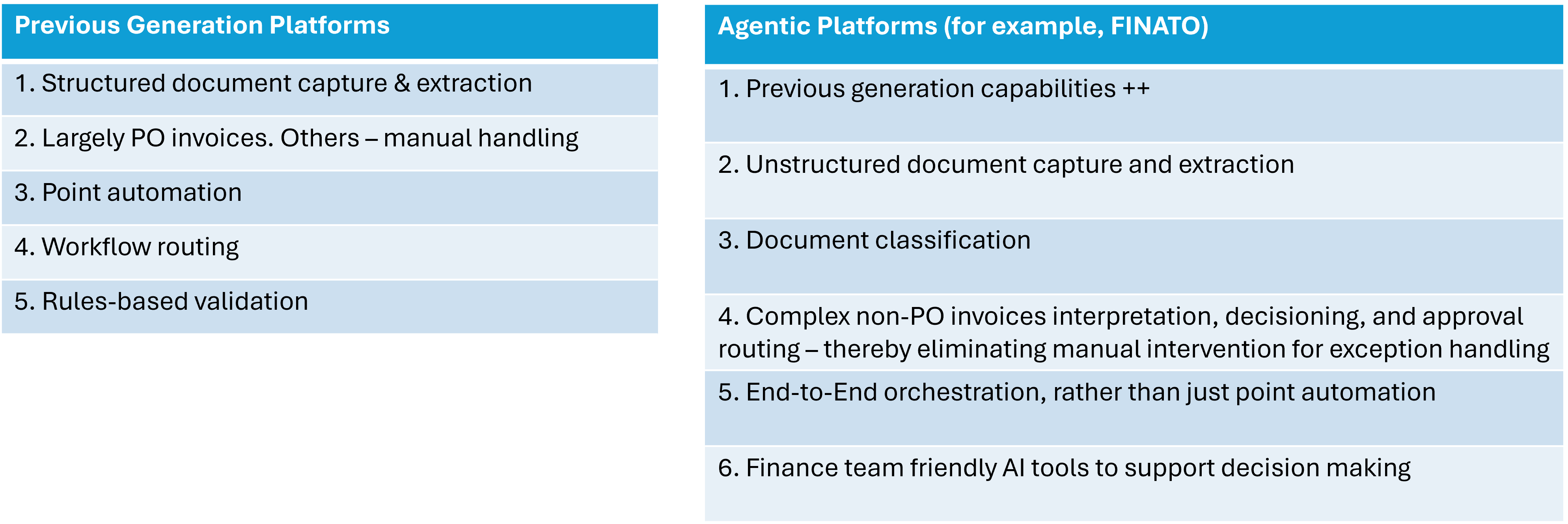
As modern finance operations requirements have evolved to require deeper sophistication from technology platforms, the FINATO platform from Datamatics has evolved to become a leading, comprehensive, intelligent platform for finance operations. FINATO’s architecture has adopted a notable acceleration towards AI-native capabilities to enable Agentic finance operations, supported by human-in-the-loop for critical decisions and approvals.
The table below outlines this specific technology evolution to AI and Agentic capabilities:
The rise of “Agentic” AI in finance operations
One of the more notable developments in platforms like FINATO is the introduction of modular AI agent components designed to handle specific functions within a broader workflow.
Examples include:
- Classification agents that interpret and categorize incoming documents
- Capture agents that extract and structure relevant data
- Quality control (QC) agents that validate outputs and flag anomalies
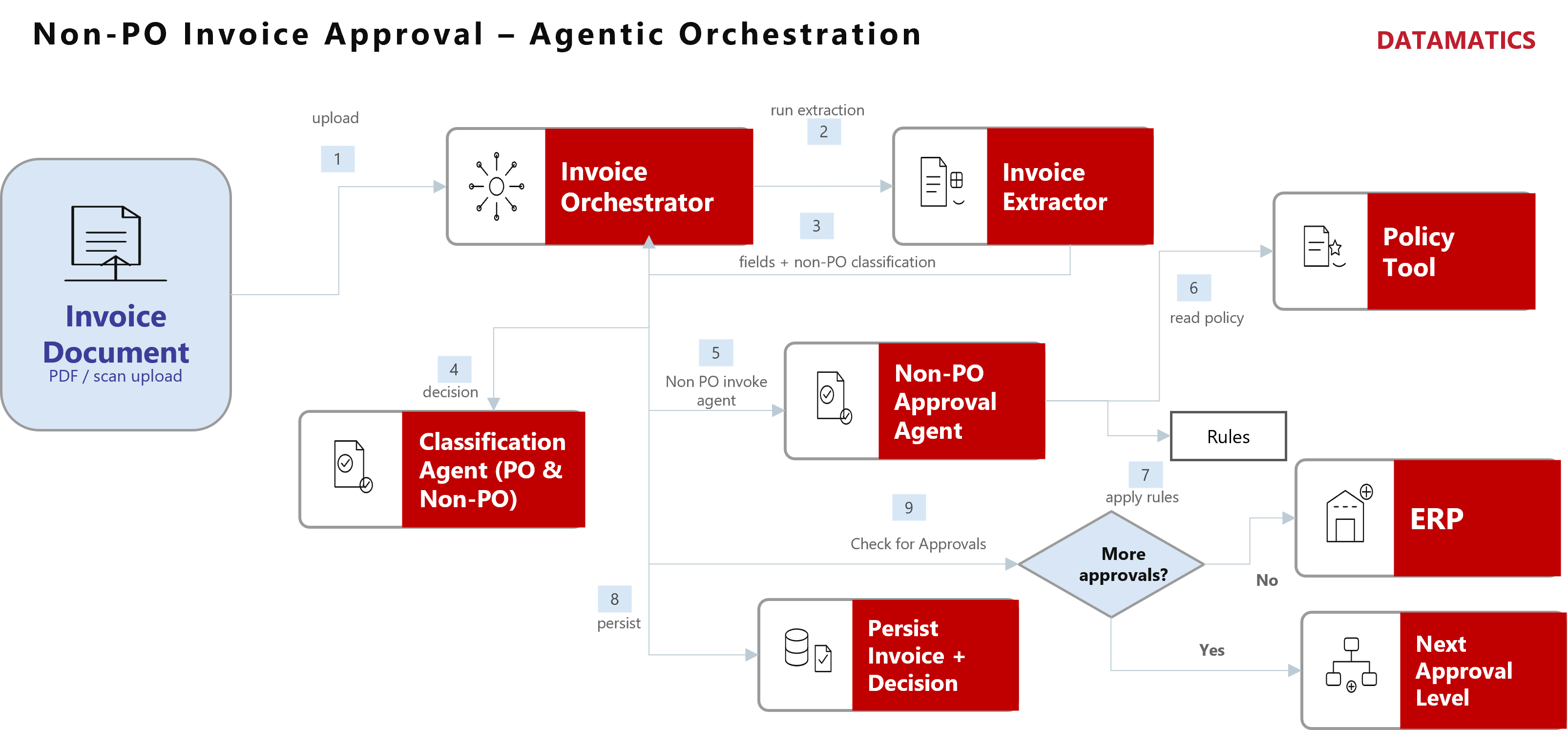
What distinguishes this model is the coordination between agents, creating a system that behaves less like a linear workflow and more like a collaborative decision engine, as illustrated below.
Conclusion: Agentic finance operations to meet the requirements of the modern-day CFO
Modern CFOs and finance leaders require technology solutions to address the increasing complexity and cost pressures that finance operations are dealing with, to ensure key business objectives, such as:
- Higher straight-through/automated processing
- Timely and correct receipts and payments
- Control and auditability
- Cost reductions
FINATO reflects the broader transformation required in enterprise finance technology to address the business requirements outlined above.
The shift toward AI-driven, agent-based orchestration suggests that the next generation of platforms will not be defined solely by automation capabilities but by their ability to understand, decide, and adapt. The metrics will expand beyond processing speed and operational costs to include decision quality and end-to-end visibility, thereby contributing to improvement in compliance.
